Creating the Corporate Soul: The Rise of Public Relations and Corporate Imagery in American Big Business
Chapter 1 - Confessions and Rebuttals: The Plight of the Soulless Corporation
10In short, the phrase "soulless corporation" quickly amassed a multitude of meanings. While some of these could be differentiated in the ways I have suggested, in practice the epithet often gained force through its capacity to evoke a variety of overlapping impressions.
1010Whether a corporation responded through a merchandising mode, an employee relations initiative, or a public relations campaign, each tactic could be bent to multiple purposes. Thus AT&T would eventually discover effective merchandising and employee relations benefits in its public relations campaign against government ownership; the Metropolitan Life Insurance Company would instruct its agents to use its altruistic public service advertisements to solicit new business; and General Electric would promote new products and foster internal morale by implanting in the public consciousness the image of its research laboratories as a "house of magic" in the service of social progress.
14Gender stereotypes, aspirations to an image of independence, and the work ethic demarcated the corporate identity. A "good businessman," by the accepted standards of peer judgment in the late nineteenth and early twentieth centuries, was serious, rational, self-controlled, manly, and direct. He was not swayed by passing fancies or emotional impulses. His self-image was that of an efficient producer, a devotee of economic independence, hard work, steadiness, and frugality.
4444In describing Marshall Field as a "born commander" among captains of industry, a reporter in 1906 noted particularly that Field's "dominant quality was expressed in a jaw of extra-ordinary width." That was exactly the image adopted in the standardized vignettes of exemplary businessmen that accompanied each major article in the magazine of business modernization, System.
Chapter 2 - AT&T: The Vision of a Loved Monopoly
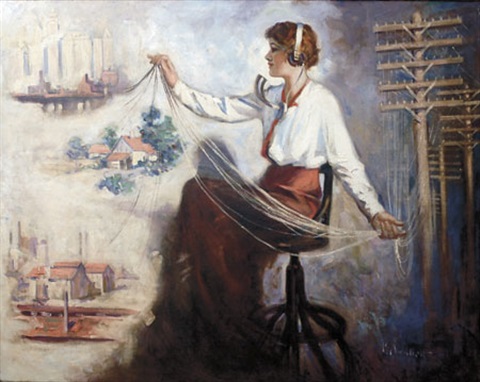
64After another two years of rather slight attention to employees, during which operators were occasionally depicted in small drawings or as parts of a montage, AT&T granted its operators their own glorified stature as the embodiment of the company. In Weavers of Speech, a painting first reproduced in a December 1915 ad and soon accorded the status of another of AT&T's aesthetic treasures, the archetypal operator gracefully and competently gathered up a profusion of wires as she offered human connection to factory, city, and rural household.
80Moreover, in implying that the "average Americans" shown receiving their dividend checks in cozy living rooms or at modest bungalow doors not only owned but also controlled the giant phone company, the ads relied on a popular misconception of control. In fact, the wider distribution of stock holdings placed more power in the hands of professional management. But the image against which both corporate leaders and the public measured a presumed tendency toward democracy in business was that of the autocratic firm of the gilded-age entrepreneur.
83Subsequent assessments of the prolonged AT&T institutional advertising campaign often noted its role in setting "the pace for employee performance." It had modeled courtesy and good service, generating high morale as well as "pride in workmanship and loyalty." Already in 1924 a business publicist in Printer's Ink, signaling out AT&T as the best exemplar of institutional advertising, remarked on how the ads had exerted "a direct and active influence over the loyalty of its great army of employees."
Chapter 3 - Corporate Morale in War and Peace: Advocacy, Industrial Statesmanship, and Humanization
89Businessmen from diverse fields, including many younger executives, became closely acquainted through cooperative wartime work. In his study of the War Industries Board, the most significant of all the wartime agencies, Robert Cuff astutely comments that the businessmen of the board reflected the decisive contemporary shift in executive leadership from "economic entrepreneurs" to "business politicians." Their role in managing the massive wartime mobilization spurred many corporate executives to larger visions and long-term planning. Having known, amid wartime unity and enthusiasm, "the uncommon experience of a transcendent national purpose," these businessmen aspired to broader goals and responsibilities.
98The most prominent solution was one that John D. Rockefeller Jr. had modeled in 1915: the employee representation plan. In the wake of the Ludlow massacre of 1914, in which the Colorado Fuel and Iron company militia opened fire on a camp of striking workers and their families, killing a number of men, women, and children, Rockefeller--the absentee owner of the company--had discovered a personal mission. He promoted employee representation as "a tool for the modernization of corporate public relations." By 1917 Rockefeller had succeeded in inducing Standard Oil of New Jersey, which had previously dismissed his ideas on corporate publicity as too idealistic, to adopt such a program in the wake of two successive strikes at its refinery in Bayonne, New Jersey, in 1916 and 1917. Near the end of 1918 Rockefeller championed employee representation at a national conference of the U.S. Chamber of Commerce and gained endorsement of a creed that incorporated his scheme for "bridging the gap between employers and employees in large scale industry.
102The Lament not only brooded over the lost satisfactions of personal contact and "hands-on" comradeship with rank-and-file employees, but it also frequently ruminated on the employees' distrust of management and their flagging morale as they lost sight of the "big picture" in the company's operations. As Hall of AT&T put it, the worker knew that "somehow he was losing his status in industry. He was lost in the shuffle somewhere...just a cog in the machine...nobody paid any particular attention to, or took any particular interest in him....He did not even know who he was working for. He did not know, in the great big corporation, just who the real boss was." Companies as diverse as General Motors and J.C. Penney reflected on the problem of bringing workers in geographically scattered operations tot see themselves as "vital and important units" in a "big nationwide institution."
103 Both models of corporate organization in the early 20th century--the army and the family--subordinated rank and file workers and placed the authority of decision making at the top of the organization chart.Could a vast corporate enterprise such as General Motors, as one of its executives proposed in 1922, both solve its internal problems and reconstruct its public image merely by presenting itself "not as resembling an octopus, but as being the parent of a large and creditable family?" Certainly the rhetoric of corporate familialism enjoyed a widespread favor among company executives and in employee magazines in the 1920s and 1930s. But it did not immediately displace the imagery of the workforce as army.
103As Peter Drucker has noted, the great armies of the past had served as the main prototype of the large organization up to the twentieth century.
104Beyond the effects of expanding size and increasing geographical reach, the systemization of information flow, as JoAnne Yates has remarked, was promoting impersonality and a "strictly businesslike tone" within the corporation.
107During World War II photographic panoramas of massed workers were seen again, often depicting actual ceremonies honoring the plant for meeting some production goal and receiving a government "E" (for "excellence") award. But despite the ease of association afforded by the war and the engagement of workers in war production, the word "army" appeared surprisingly seldom as a metaphor for the workforce.
110Although the first issues of employee magazines often assured workers that "this paper is your paper" or urged them to take the magazine "as your own, for it was sincerely planned and designed for you," employee magazines were vehicles of downward information and could hardly be anything else. Their editors were headquarters employees who reported to top management.
110 Suggestion plans offer a great opportunity for this kind of individual recognition.Ivy Lee described the optimum employee magazine as "just like a small town weekly which tells the news about the neighbors." Its goal, he added, should be "to bring into its columns as far as possible mention of every man on the railroad who does anything of consequence."
116 The dual function of things like suggestion systems and brainstorming--morale, advertisement, efficiency--is not unusual but continues a long tradition of paternalist corporate policies.Largely precipitated by the rising tide of American Federation of Labor (AFL) unionization during the World War I era, these schemes of employee work councils and company-funded unions became quite fashionable among self-consciously "modern" large employers by the beginning of the 1920s. By the mid-1920s, Kim McQuaid calculates, nearly five hundred corporations, including such giants as AT&T, International Harvester, Bethlehem Steel, Goodyear, and Standard Oil of New Jersey, had established some form of nonunion work councils.
Chapter 4 - A "Corporation Consciousness": General Motors, General Electric, and the Bruce Barton Formula
130At the end of 1922 Barton won not only this challenging General Motors project but also another "glittering account," that of the General Electric Company. Virtually simultaneously, two of the emerging corporate giants of the new era of business dominance and welfare capitalism had committed themselves to a visionary young agency for major, innovative advertising campaigns.
134More than any other figure in this era, Barton empathized with the aspirations of corporate executives for an ennobling sense of their businesses as agencies of great public service. He recognized their impatience to infuse an espirit de corps within their increasingly distended and bureaucratic organizations.
134During World War I Barton experienced the joys of sacrificial labor while chairing the publicity committee of the United War Work Campaign, a war service confederation that linked various religious and secular organizations.
144In Barton's mind no goal surpassed the internal mission--that of forging a corporate consciousness. Barton's agency steadily pressed a "resale" scheme--a campaign to "sell" institutional adveritisng within GM itself. Ads from the goodwill series were posted in factories and supplied as jumbo posters for the car dealers to display in their windows. Reproductions of these ads, with their purposes explained, appeared in sales bulletins and divisional publications. GM's headquarters staff used reams of paper to duplicate and circulate multipage compilations of commendatory letters evoked by the campaign. Personnel managers were enlisted to spread the "new consciousness."
149Barton's command performance had carried the day at General Motors through his astute reading of the internal needs of that corporation. His tour-de-force at General Electric again displayed his capacity to promote service and business ideals while anticipating merchandising strategies and internal dynamics. Barton approached the company's prospective clients with a sensitivity to what would now be termed its "corporate culture." He relished the opportunity to shape that culture.
151154Although [GE] encouraged publicity about its leading engineer, the brilliant hunchbacked dwarf Charles Steinmetz, as a fascinating, "gnomelike wizard," it had largely adopted a low-profile strategy, on the assumption that any media attention was apt to prove unfavorable.
162 Internal divisions not only between workers and management but also between divisions and headquarters.Barton and the GM and GE executives concurred in seeing the institutional campaigns as tools for achieving corporate integration. In all large companies, Barton observed, a struggle took place between "a headquarters point-of-view and a division point-of-view." Barton always saw himself as the spokesperson for the headquarters. He sought to foster headquarters ascendancy with messages that would hearten and unify all levels in the corporation.
Chapter 5 - To Be an Institution: The Service Ideal and Institutional Style
194During 1921 and 1922 Du Pont briefly suspended its disbelief in the usefulness of institutional advertising and mounted a national campaign to enshrine the figure of the chemical engineer. Each selection in this explicitly numbered series of ads carried an idealized representation of the aproned scientist. "This is today's Prometheus," the first ad in the series announced. Anchored like a statue to a non-descript sculpted base, the chemical engineer, sleeves rolled up in testimony to his commitment to practical experiment, gazed upward in heroic profile at the test tube in his hand. Du Pont eschewed any subtleties, bluntly associating the heroic chemical engineer with its own "extensive chemical staff." The ads unblushingly claimed: "His visions have crowded the highways of commerce!" and "In little more than a Century, He has advanced Civilization by Ten Centuries!"
Du Pont's short-lived campaign aimed mainly to promote the company's image in the eyes of potential employees among young college graduates.
Chapter 6 - The 1930s: Save the System
203By precept and example, Barton suggested that the great battle on behalf of free enterprise had to be fought through individual initiatives by the major corporations themselves. Although he did not criticize the efforts of the NAM, Barton obviously considered them only complementary to broad-spirited public relations campaigns by the great "flagship" corporations, such as those he had recently converted to the cause. Unattuned to public relations subtleties, the NAM lacked Barton's modulated voice and his flair for the dramatic but positive, generous corporate gesture. In Richard Tedlow's phrase the NAM "sought to sell free enterprise the way Procter & Gamble sold soap."… Barton's eloquent appeals, both at the NAM convention and at other business gatherings over the subsequent six months, helped underwrite a wondrously self-vindicating stance by business leaders, one that justified a new emphasis on public relations. So widely and uniformly was this posture adopted that it warrants a categorical label: "the Confession." Executive after executive confessed that he and his peers had unwisely ignored the need to explain and defend the greater mission of his own company and of the capitalist system. The reason for this failure, each piously protested, had been his single-minded devotion to the production ethnic.
205Bruce Barton played on this potential sense of embarrassment, goading the great producers of consumer goods to action by telling them flatly that they had been beaten at their own game. The best advertiser of the previous three years had not been any of the great manufacturers or prominent advertising agencies, Barton taunted. It had been Franklin D. Roosevelt and his federal bureaucracy.
206The more they thought about Roosevelt, and the more often they suffered defeats at his hands, the more corporate leaders concluded that the New Deal had outstripped them in effective use of radio and films for "institutional" and image-creating purposes and the more they resolved to apply their skills to the use of these media in public relations. Recognizing that the secret of Roosevelt's success lay in his capacity to speak the "language of the common man," they urgently pursued their own quest for a popular idiom in which to translate their corporate messages and enlighten the economically illiterate.
213To speak in the idiom of average citizens meant also to place the topic in the context of everyday experiences. Many corporations and advertising agencies considered this strategy an apt response to the constantly repeated warnings about the need to humanize the corporation. In a folksy setting the corporation could carry on friendly "conversations" that placed great economic principles and institutions within a scale that simple neighbor folk could grasp. Advertising Age praised ads that combined local references with colloquial speech. It noted how Nation's Business , the organ of the national Chamber of Commerce, had managed "to separate the word 'big' from the word 'business' in the public mind." The magazine had done this by depicting business as composed not of "a mysteriously intangible something" but "simply of such men as the corner grocer and the man who sells shoes."
214The radical change that these efforts represented in corporate imagery is perhaps best exemplified by the title of an article in the J. Walter Thompson house organ in 1937. With an apparent sense of astonished discovery, the magazine declared: "Workers Are People". Confessing earlier sins of omission, the author of this feature article noted that "to many of us a factory is a building full of machinery and populated by a strange variety of human being who borrows many of his characteristics from the machine." But a resurgence of concern for worker morale (inspired by an unprecedented, mounting level of unionization and massive strikes) had now led the agencies to discover the "employe of almost any large corporation" as the true "forgotten man" of the age.
219The Du Pont penchant for obscurity and narrow attention to business was shattered in 1934 by the publication of H.C. Engelbrecht's Merchant of Death, an exposé of the immense profits reaped by munitions traders during World War I.
231In a pamphlet titled The Philosophy of Customer Research, Buck Weaver amplified this theme of attention to the individual into a full-fledged prescription for the ills of mass society. Customer research, he proclaimed, was nothing less than a tool for "human understanding." As a business grew larger, he argued, its need "for reckoning with the tastes of the individual" grew greater because of the widening gap between customer and business executives.
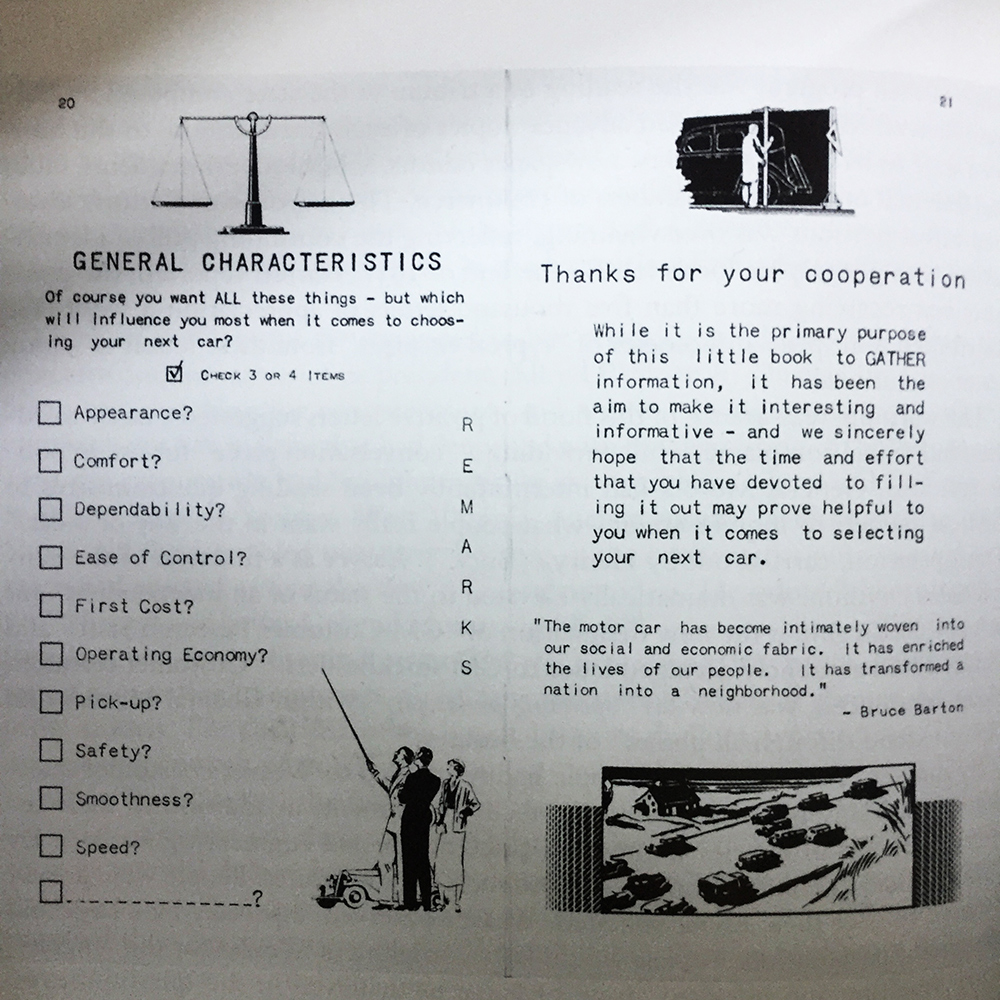
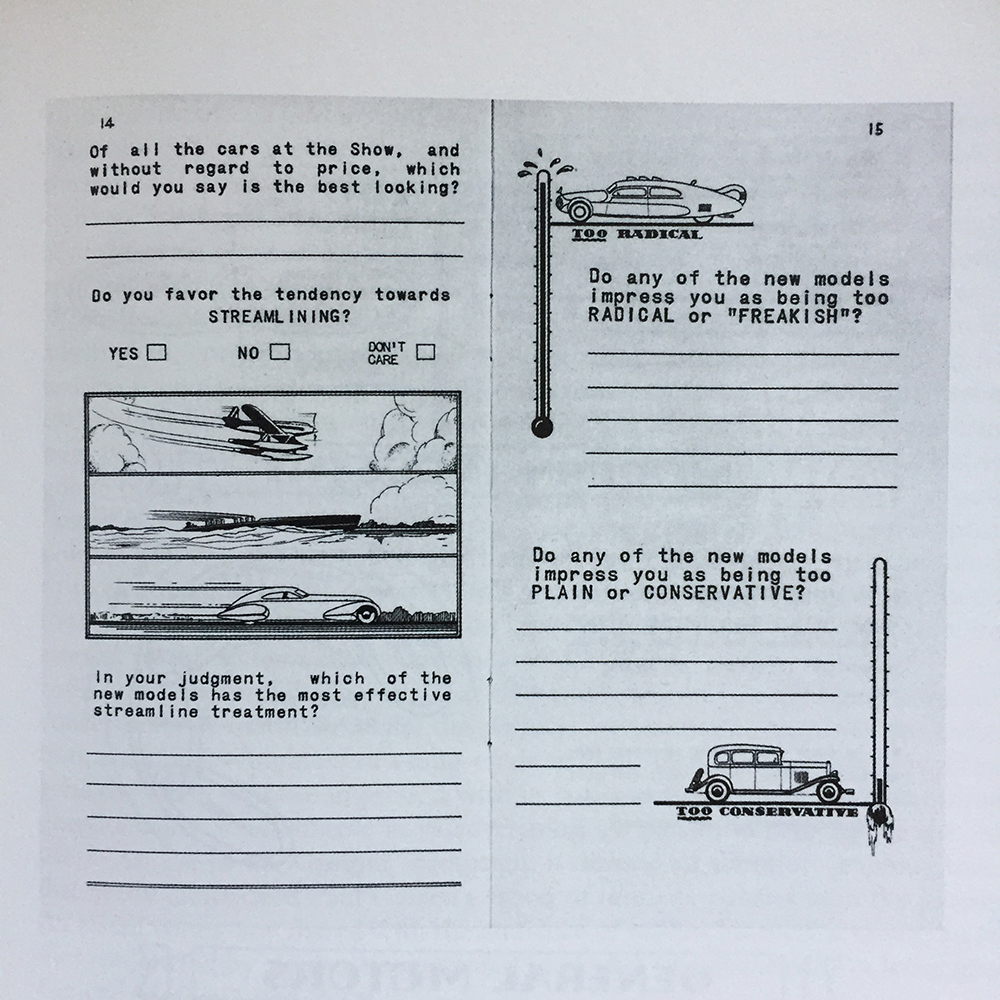
235Customer research thus gained a place in GM's anti-New Deal propaganda. Increasingly alarmed by the government's inroads on the autonomy of business executives, Sloan (who would later refer back to his "tirades" against the New Deal) and other GM leaders emphasized the democratic aspects of customer research in their efforts to advance the economic education of the American people. In 1936, for instance, a GM institutional ad featured a story on the customer research operation during an election season to persuade Americans to look to the business corporation, rather than to perpetuation of the New Deal, for the nation's well being. The ad series "Who Serves Progress Serves America" sought, according to a Harvard Business School analysis, "to teach fundamental economic truths in terms of specific examples chosen from General Motors experience. While Roosevelt's New Deal might claim to serve the people, the argument in the ads implied, corporations such as GM, by sending out "more than a million letters to car owners" assessing their "tastes and desires," had in fact made themselves the people's faithful representatives.
245 Suggestion boxes and "creativity" emerge out of several decades of intense, self-conscious efforts among businessmen to promote individual initiative in a capitalist system.Whereas the specific marketing and financial needs of individual companies still prompted some corporate image advertising in the 1930s, as it had in previous periods, businessmen's dismay at the inexplicable public denigration of the economic system, and their fear that it faced an hour of extreme danger, were the main impetus for the new public relations craze. The perceived need to save the system reshaped the search for "soul" among large corporations in the 1930s and led to more sophisticated ways of suggesting such soul through populist rhetoric and imagery.
Chapter 7 - The Corporations Come to the Fair: A Visit to the Factory Transformed
255The strategy of operational-aesthetic displays enticed many production-oriented executives to do what they liked to do best: show off their factories. Corporate presidents of the era took great pride in the size and extent of their manufacturing works as vivid testimonies to their entrepreneurial prowess.
256Visitors could also admire the various toward signs of the "inward spiritual grace" embodied in the company. These ranged from the female workers' "neat uniforms with dainty white caps" to the flower boxes on the separate roof gardens for men and women and the didactic stained glass windows of the company auditorium. They could appreciate the extent to which Heinz workers were, "even as they work[ed],…surrounded by appeals to their good taste and finer sensibilities" in the form of paintings, statuary, and inspirational mottoes.
281Throughout the 1920s, advertising experts continuously harangued their colleagues on the necessity of "short words—short sentences, simply-expressed ideas." Copywriters had to recognize that "average intelligence is surprisingly low." Some of the most successful agencies and advertisers in the early 1930s were those that took the most pessimistic view of audience intelligence, aimed the lowest, and turned to tabloid and comic-strip formats. New, more scientific, studies of audiences failed to restore stature to this hypothesized public. At the Young & Rubicam agency, where George Gallup was pursuing his studies of readership, an agency memorandum observed: "Invariably our interviewers are amazed at the low level of taste—most of them call it stupidity—of the typical woman newspaper reader."
285 Businessmen see New Deal as an effort to regiment, redistribute, and fundamentally to divide the pie that already exists. Creativity is about creating, about multiplying abundance, expanding the pie.At his well-publicized dinner for scientists, businessmen, and civic leaders at the reopening of that fair in 1934, GM president Alfred Sloan had aimed to give his company "a priceless identification with scientific progress." General Motors conceived of this identification as an important political stratagem as well as a long-range marketing device. The nation was turning a sympathetic ear to Roosevelt's New Deal programs of restrictions, security, and "regimentation," Sloan and other GM executives concluded, because people had lost their faith in progress and in the future. Americans, Sloan lamented, were being encouraged by New Deal policies to give up trying to produce a greater abundance and to turn instead to government to "divid[e] up what we already have." To counter this deplorable drift in sentiment, it was crucial to remind people of new worlds still to be conquered.
288Furthermore, in 1938, with the help of copywriter Charles Lewis of the Arthur Kudner advertising agency, it discovered a post-visit technique for "crystallizing the imprint of General Motors on the community." A day or tow after the caravan left town, General Motors would insert a reminder advertisement in local newspapers. For this purpose Lewis created what was immediately recognized as an advertising masterpiece. Entitled "We Hope We Set a Boy to Dreaming," the ad captured the sincere missionary instinct that inspired many of Boss Kettering's protégés among the Parade's technicians and lecturers. They had savored each instance in which a young boy left the demonstrations to go try his own experiments. (If any girls did so, the Parade leaders did not officially recognize it; current conventions associated science and technology exclusively with males.) Now their sense of mission was incorporated into an institutional creed that tied huge General Motors to a hallowed image of the hometown boy as curious explorer and aspiring inventor.
In the powerful illustration for this ad, a boy of about twelve, surrounded by a microscope, test tubes, and beakers, gazes upward, his cheek against his hand, into an unseen, consecrating source of light. His "dream" is obviously one of idealism and aspiration, one that will carry him, the text affirms, "on a road of usefulness and service to himself, his country, and his fellow men." In a subtle ideological pitch that translated the large industrial laboratory into an endearing image of boys pursuing their visions by "turning to their home chemistry sets…, toolkits, and workbenches," General Motors reminded hometown America that "the real hope for continued progress lies in the spirit of individual initiative." Thus, the promise of the nation's future would be realized only if the boy--and by extension, the corporation--could pursue his visions without impediment.
295Westinghouse devised one of the most elaborate scenarios to reaffirm the free enterprise system through its display of technology. The company energetically promoted showings of its movie, The Middleton Family at the New York World's Fair. The eighteen-minute-long film dramatically recounted a visit to the Westinghouse displays by a typical American family that, before this visit, had faced troubling prospects. Fourteen-year-old Bud, discouraged by the depression, was convinced that no new frontiers or opportunities existed and had dourly reconciled himself to the motto of his high school's most recent graduating class, "WPA, Here we come!"
306Futurama's vision of the future not only associated General Motors with foresightedness, technological sophistication, and a concern for highway safety; it also promoted the larger GM ideology. The soundtrack reminded visitors that the exciting future they were experiencing had been "enriched...by a new understanding of the true function of industry as an integral part of the nation's social and economic life." If that tribute to free enterprise was vague and muted, the "Press Guide" proudly quoted the statement of GM chairman Alfred Sloan that for industry to move forward toward this future it was necessary to "destroy the economic barriers that now prevent the essential expansion of enterprise...and that repress the spirit of individual initiative."
Chapter 8 - Little Towns and Big Corporations: The Wartime Imagery of a Nation United
317Two specters haunted business leaders during the year before the bombing of Pearl Harbor. One was the fear that a vast expansion of the nation's industrial plant might saddle companies with a dangerous capacity for the overproduction that many associated with the recent depression. The other apprehension, in the wake of FDR's 1940 election victory, was that centralized planning, a proclivity for trustbusting, and the regulatory "regimentation" that characterized the New Deal in the eyes of many corporate leaders would accelerate under war conditions. War would certainly bring the additional economic controls of a "war socialism," which might then prove permanent. These tendencies, President Charles E. Wilson of the General Electric Company observed in November 1941, meant that in the immediate aftermath of war the free enterprise system would "face the greatest challenge in its history."
319A mood approaching self-pity emerged in such public commentaries as that of Charles Wilson of General Electric in "Can We Save Free Enterprise?" Bruce Barton, now an ad agency "elder" as well as a former congressman, shared his own gloomy predictions with his agency's client, the Du Pont Company. At a private "advertising clinic" in mid-1941, the agency executives passed along Barton's observation that "any American company" had to be viewed as a citizen beleaguered once again, who would "do well to come out of this present mess with both his shirt and his reputation." Later in 1941, drawing on his instinct for the commonplace touch, Barton described "all of American industry" as sharing "a mental state like anticipating a trip to the dentist." Even after the United States had entered the war, the trade journal Advertising and Selling still talked about the impending "doom of capitalism." Citing a recent survey by the Psychological Corporation, the journal reported that "a large majority of business men" believe that "the jig is up...that free enterprise is doomed."
320
Fortuitously, but only after agonizing delay, federal officials divulged a wartime tax policy that made publicizing the corporations' war service economically attractive as well. In May 1942, Secretary of the Treasury Henry Morgenthau announced that the federal government would consider "ordinary and necessary" advertising costs--those that bore "a reasonable relation tot he business activities in which the enterprise is engaged"--as deductible for corporations before calculating their profits. This deduction was of great importance, since an excess profits tax of 90 percent was in effect. Rather than allow money to be siphoned off into the federal treasury at that rate, companies could spend these funds on advertising at minimal cost. In effect, the government was heavily subsidizing forms of advertising that were "essential" only in that they kept established corporate brands and images before the public and secured whatever contributions these corporate messages might make to wartime morale. Institutional or public relations advertising rapidly escalated from only $1 million in 1939 to $17 million by 1943.
321Beyond expanding their institutional advertising and reinforcing the morale-building aspects of their plant city activities, many major companies pursued other wartime avenues for the long-range molding of their corporate image. Before the first eyar of American participation in the war had passed, most top executives had assigned staff to compile a full record of the company's wartime activities. Liberal allowances for publicity in war contracts made possible lavish publications, flattering to employees and useful in promoting noncommercial images of the corporations. By 1943 AT&T had a full-time information manager and former journalist on the road gathering material for such a war history and Standard Oil of New Jersey had commissioned leading artists and photographers to develop a visual record of that company's wartime service. General Motors, seeking "more fully [to] capitaliz[e] the war history data," decided to document, in separate albums, the contributions of each division of the corporation.... Apart from architectural expressions, and a smattering of company-financed histories over the previous decade, these war albums constituted the most elaborate visual testimonies that corporations had yet dedicated to their sense of their own significance in the nation's history and their status as major national institutions.
336As corporations turned to common-folk protagonists and imagery to associate the "fifth freedom" of free enterprise with the wartime goals and values of average Americans, many also claimed for themselves a virtue often vaunted as an intrinsic aspect of national character. This was the trait known in familiar, Main Street vernacular as "American know-how"--a shrewdness of judgment based on experience and a quick capacity to master technical apparatus. The term carried strong democratic connotations. Clearly distinct from book learning, know-how was the kind of expertise available to all through everyday experience. Historically, it recalled the tests of frontier life. Suggesting the mastery of skills essential for personal independence, know-how attained the moral authority of an association with traditional republican values.
The know-how motif in wartime corporate imagery derived both from the search for a tasteful way to brag about corporate accomplishments in war production and from a very specific managerial concern. Vignettes of corporate self-congratulation that emphasized the application of know-how to war production highlighted the importance of the fifth freedom. The opportunities for risk and reward under free enterprise, they asserted, underlay the particularly American attribute of know-how. By stressing know-how more than size, the industrial giants positioned themselves as simply the nation's handymen and tinkerers writ large. The initiative and inventiveness that stemmed from America's pioneer past, and which had long been lodged in the technical ingenuity of small-town mechanics, was thus defined as a quality that linked the industrial corporation with the Main Streets of America and united both for inevitable victory in war.
A more specific motive for the wartime celebrations of corporate know-how lay in the reaction by automakers to union initiatives--like that of the United Auto Workers in the immediate prewar period--that challenged traditional management prerogatives. Walter Reuther's bold proposal in 1941 for the creation of a tripartite industrial council of managers, unionists, and government representatives to accelerate the auto industry's production of planes had shocked and embarrassed company executives. In proposing an unprecedented sharing of managerial power and promising production efficiencies in the process, Reuther had challenged the notion of management's monopoly on significant know-how. Although GM executives sought to refute Reuther's charges of inadequate mobilization by the manufacturers, an internal GM report in February 1942 suggests that the Reuther plan did have an impact on company policies. The author argued that the corporate should carefully distribute war projects among GM plants in order to please the authorities in Washington. He concluded that this would be the best way to get "the 'monkey off our back' in this matter of joint labor and management control."
338At General Motors, the company's Public Relations Policy Group agreed that its "major task in 1943" was to "tell the production story but with increased emphasis upon the managerial 'know-how' aspect." Already in 1942 a series of ads "in hundreds of newspapers" had begun relating GM's "Good News from the Production Front." These accounts placed particular emphasis on "the part that management planning and know-how" had played in achieving production records. It was vital, in the company's strategy, to convince the public that "supervisory 'know-how'" was irreplaceable. Several months earlier, as he began to work on a war history of General Motors, Henry Weaver had observed that too little effort had been devoted to telling the "story of the brain work, the planning, the creative effort, the engineering skills and inventive genius...which are really the essence of the mass production idea." More emphasis on these critical elements of managerial efficiency in war production and less emphasis on the assembly line, he argued, would "correct the impression that labor is entitled to an ever-increasing share of the industry's earnings."
339The Ford Motor Company recurrently returned to the know-how theme in the midprogram commercials on its news commentary show, Watch the World Go By. Although generally disinclined to brag about its war service, Ford enthusiastically reviewed various instances in which "industrial brains, fostered through the system of free enterprise," had enabled American industry to shorten the war. Constantly alluding to "engineering genius," "brainpower," and "industrial 'know-how,'" Ford concluded that no other factor so clearly distinguished the "American system of free enterprise" from the "Nazi 'slave system'" as did the sharing of "know-how" in America. Not to be outdone, the Chrysler Corporation mounted its own tribute to managerial know-how in 1944 with a series of advertisements in large-circulation magazines on the theme of "imagination and teamwork." While including workers and small business suppliers as part of the team, Chrysler clearly identified management as providing the crucial element--that of imagination.
346The appropriate alternative to government planning, most agreed, was vigorous individual planning by thousands of business corporations--a form of planning, as a leading Kodak executive put it, that came "from the bottom up rather than from the top down." New engineering and styling advances had to e accomplished as quickly as possible, so that, as Sloan commented of GM's products, "cars pass more rapidly from the first owner to the scrap pile." World of tomorrow advertising posed a dilemma in that it was needed to "agitate the imaginations and desires of post-war consumers" and thus stimulate a "radical reversal" of popular thinking--away from the wartime "emphasis on self-sacrifice and absolute needs."
346 Consider how the flying car, as opposed to, say, the perfectly managed urban roadways of Futurama, perfectly marries suburban living with futuristic consumption.If this dilemma ever vexed the creators of wartime corporate imagery, they certainly revealed little hesitancy or confusion. Without any debates or conversations that I can discover, either public or private, they simply banished the concept of the future as modernistic city. Instead, they found ways to bring home the imagery of technological utopia to small-town and domestic settings. Advertising illustrations showed streamlined houses, barns, and garages--almost all in small-town, suburban, or rural scenes.
350 Suggestion systems serve as the infrastructure for this philosophy in the workplace.One of the favored elements in conservative philosophies of free enterprise had invariably been the story of occupational and social mobility, based on merit, under conditions of equal opportunity. Those who spoke for the giant corporations bore the burden of demonstrating that opportunities for young men in America had not vanished with the coming of the industrial behemoths. Their solution was to argue that mobility was just as possible within the large corporation as it had been without and that the needs of large corporations stimulated the prosperity of many small businesses. In the face of increasing evidence to the contrary, they continued in the 1930s and 1940s to assert, to the applause of other corporate leaders, that virtually all their top executives had come "up from the ranks."
Conclusion - Like a Good Neighbor
358Companies with over ten thousand workers increased their share of industrial employment from 13 to 30 percent of the nation's total between 1939 and 1944, while those with a hundred employees or fewer dropped from 26 to 19 percent. War production contracts favored the giant manufacturers, as did the processes of postwar reconversion.
362Although individuals, and occasionally those united in voluntary groups, did not lack all capacity to counter or even undercut the flood of corporate imagery form the corporations, the encounters became increasingly disproportionate as the twentieth century wore on. The citizen incessantly addressed as favorite, friend, neighbor, and even family member of the corporation had to develop a prickly, discriminatory wariness in order to resist acquiescence and maintain a realistic sense of conflicting interests. Corporate publicity was hardly the only agent in the distortion of meanings in popular discourse, but its omnipresence and political thrust have ensured corporate imagery a prominent role in public dialogues on family, class, community, and politics.