"Business Finds Its Voice"
Part I
113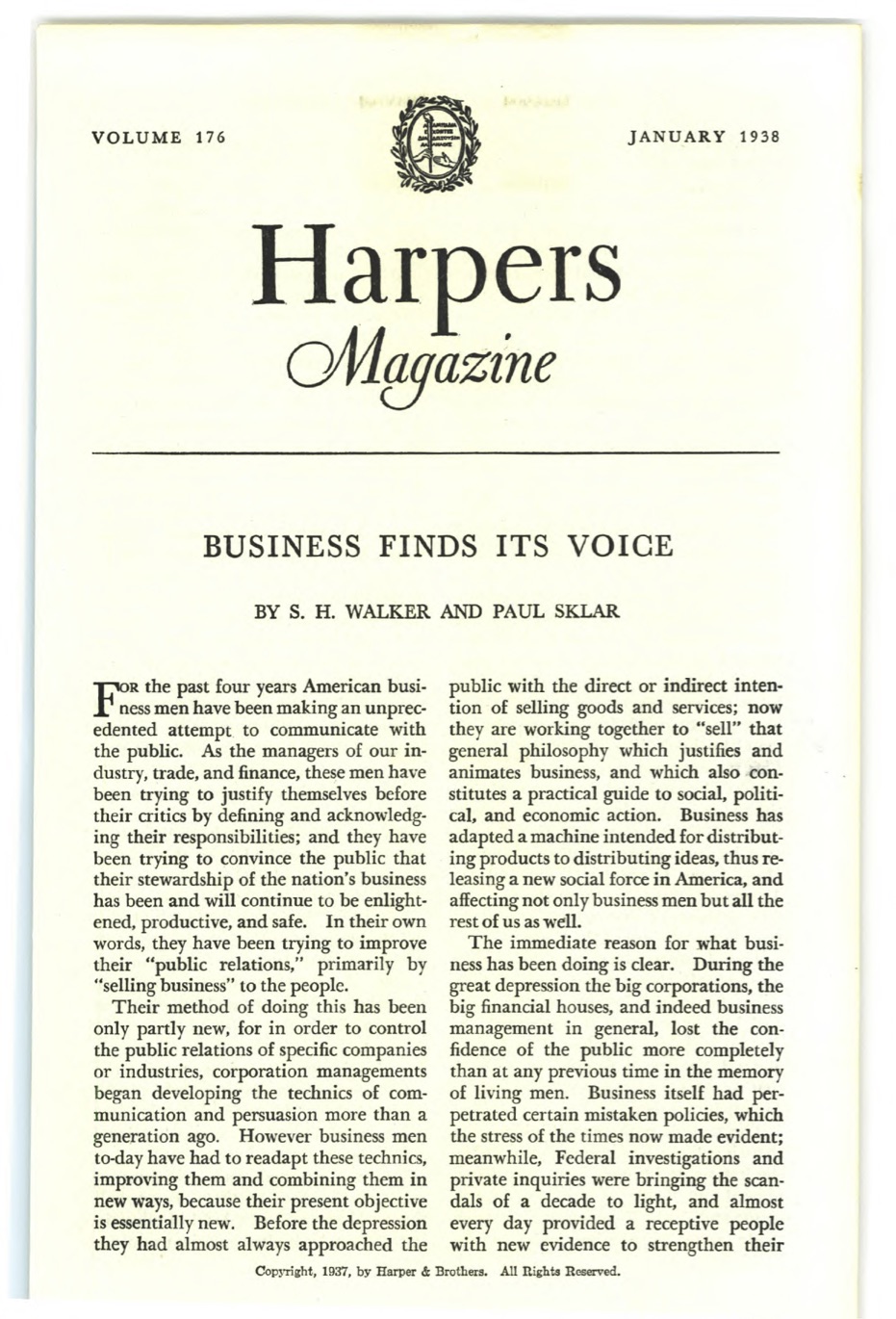
Business has adapted a machine intended for distributing products to distributing ideas, thus releasing a new social force in America, and affecting not only business men but all the rest of us as well.
115Something more was needed, something Walter Lippmann, for one, struck on a long time later, when he explained the General Motors strike of last winter in these words:
"The sickness of General Motors is due, I have become convinced, to the failure of the management to realize that a corporation which employs over 200,000 men in thirty-five communities is no ordinary industrial plant.... To get on well with 200,000 American citizens is not a matter of ordinary business management. It is like governing a large city, and to conduct the government successfully it must be handled by men who have political gifts."
115It is hard to realize just how rationally and thoroughly business leaders have worked out this broadest form of their idea, and how explicitly they urge it, as, for instance, Bruce Barton did in 1935, in an unusually well-received speech before the National Association of Manufacturers. First he explained his conception of the task at hand. "Research, mass production, and low prices," he said, "are the offspring of business bigness and its only justification. This story should be told, with all the imagination and art of which modern advertising is capable."
118General Motors financed the most important series, a succession of spreads in four colors in the Saturday Evening Post, Collier's, and other magazines of big circulation. A boxed paragraph in each advertisement described the results of research in General Motors' laboratories, but the text, week after week, was much more general in nature; for the theme was "Who Serves Progress-Serves America," and the arguments explored the advantages of "the American system of free opportunity, free initiative, free competition."
Part II - Motion Pictures and Combined Efforts
321It is the "educational" audience that business men regard as most valuable. As Lewis H. Brown, president of the Johns-Manville Corporation said at the 1937 convention of National Advertisers:
"We must, with moving pictures and other educational material, carry into the schools of the generation of to-morrow an interesting story of the part that science and industry have played in creating a more abundant life for those who are fortunate to live in this great country of ours.... After all, it is our own fault if three-fourths of the teachers in our schools and colleges have never been in a factory. It is our fault if all they know about business and industry is what they read in books and Karl Marx or Henry George."
326The General Motors Corporation has been making films steadily, for a variety of purposes. "Progress on Parade," an Audio production, narrated by Lowell Thomas, Edwin C. Hill, John B. Kennedy, and John S. Young, and released in early 1936, expresses on film the basic theme of the magazine campaign which we described last mont, "Who Serves Progress Serves America." The printed advertisements were couched in very general terms, expounding "the advantage of multiplying wealth instead of dividing it." "Progress on Parade" took another way to the same end. As the YMCA explained it, in a brochure intended to sell the film to non-theatrical exhibitors: "America's number one automobile designer...is John Q. Public...it isn't industry that changes, it is YOU!"
327In 1934 the corporation began to make the acquaintance of boys between the ages of nine and fifteen by sponsoring, through Chevrolet, the annual "Soap Box Derby"--a series of downhill races for soapbox automobiles, with national finals for the regional champions. Of this undertaking C.P. Fisken of Chevrolet Co. has been quoted in advertisements as saying: "It's the Soap Box Derby against the soap-box orators. How can you have soap-box orators when thousands and thousands of boys are looking for soap boxes."
327In 1936 Paul Garrett told the executives in conference at White Sulphur Springs: "Since 1929 nearly 17,000,000 young people have come of age. What do they think of the ability of industry to provide for their future?... What is going to be their verdict in the current conflict between individualism and the corporate state?"
Part III
428
From the start there have been skeptics in business who could not share this feeling, and now their view is beginning to prevail; in fact, this has been palpably true ever since the election of 1936.
Many business men had got up on the morning of November 3, 1936, convinced that Mr. Landon was about to be elected; probably more of their number had felt that Mr. Roosevelt would win, but none of them was prepared for the landslide that came. The vote was so overwhelming an expression of public opinion that it gravely shocked businessmen all over the country.
429An influential advertising man, Edgar Kobak, vice president of the advertising agency Lord & Thomas, put it this way, addressing a business group late last year:
"Educate the public! That's become a catch phrase. And it's used too often by the very people who don't believe the common people can think for themselves. You are the people, the common people--to other businesses. Do you need educating? The sooner we stop thinking of public relations as a job of mass hypnotism which will make the public think the way we want it to think, the better for all of us."
431You will notice that such activities as the General Motors Dealer Coordination drive toward more than one objective; increased sales, for instance, and more satisfactory handling of used cars, as well as better public relations. Indeed, this feature is the great strength of the whole effort to control public relations by creating an appropriate organizational structure: whatever reorganization has to be carried out may be made to justify itself--philosophically, financially or legally--on any one of several grounds. And this is pre-eminently the advantage of the policy of decentralization.
Mechanically, to decentralize is to convert one operation or plant into several smaller ones, geographically scattered, or to divert a necessary expansion into new localities; and at the same time to throw an increased administrative responsibility into the hands of the unit managements. In other words, industrial decentralization in practice consists of the centralization of capital, the decentralization of administrative authority, and the centralization of the policy-making power.